
Content
Tips for Creating an Exercise Schedule
5 Jan 2026
2 Min Read

People are often confused about how to start an effective active lifestyle. Moving or exercising without proper planning can actually lead to injury, which may eventually cause someone to become inactive again.
Fitness trainers always create a one-year training periodization plan for their athletes.
This is done so that all training sessions are well planned and the training load can be increased gradually. This idea should also be applied by people who want to start an active lifestyle and exercise regularly.
Five main factors in creating an exercise schedule for beginners:
- Consistency
- Active Recovery
- Variety
- Challenge
- Track / Record
1. Consistency
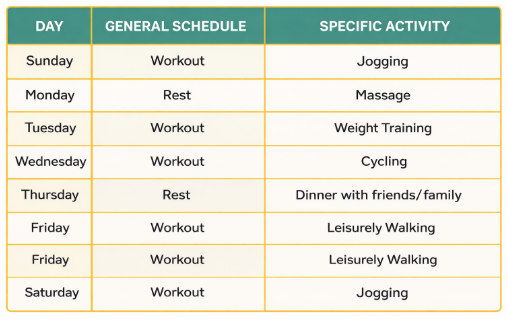
Start creating your exercise schedule by choosing 5 workout days and 2 rest days per week that fit your daily routine. Choose a workout time that you can commit to consistently a time when you have more free time compared to others, such as in the morning or in the evening after work.
2. Active Recovery
Choose two days in a week, consisting of one workout day and one rest day. Active recovery means staying active but at a lighter intensity compared to workout days. The goal is to give your muscles a chance to recover while still increasing your range of motion and keeping your body active.
Some activities you can choose for active recovery include using a massage roller, low-intensity yoga, leisurely walking, relaxed swimming, doing house chores, and others.
Example :
3. Variety
Doing the same activity repeatedly every day is not only boring but can also increase the risk of injury. Add variety to the exercises you do most often. For example, alternate jogging with long-distance runs, middle-distance runs, or replace it with cycling around the city.
4. Challenge
Every routine needs goals and challenges. Don’t forget to always challenge yourself—with challenges that are achievable—so you don’t become frustrated and lose motivation to exercise.
For example, in the first month, jogging for 20 minutes is enough. Then gradually increase the duration or distance as your physical ability becomes stronger.
5. Track / Record
For this part, you can automatically save all your activities using trackers and the LiF app. Recording your activities is important so you can see your progress data throughout your exercise routine.
After you become consistent with your exercise schedule, you will reach a point where your body feels less fresh when you don’t exercise or stay active at all. This indicates that endorphins have started to work. These hormones are often called “happy hormones,” so people who are used to being active may feel a lack of them when they suddenly become inactive.
Creating an exercise schedule should also be adjusted to any medical conditions you may have. For example, for people with diabetes mellitus, it is highly recommended to do short strength training before jogging to avoid hypoglycemia (low blood sugar). People with hypertension can choose light, dynamic strength training; examples can be found on YouTube or Instagram.
Especially for people with osteoarthritis or knee joint pain, recent studies actually recommend being more active, although the exercise intensity should be much lighter compared to others. This approach has been shown to help improve quality of life and physical function in people with osteoarthritis.
This article was written by Dr. Amanda Dianky, AIFO-K, a General Practitioner and Clinical Exercise Physiologist